

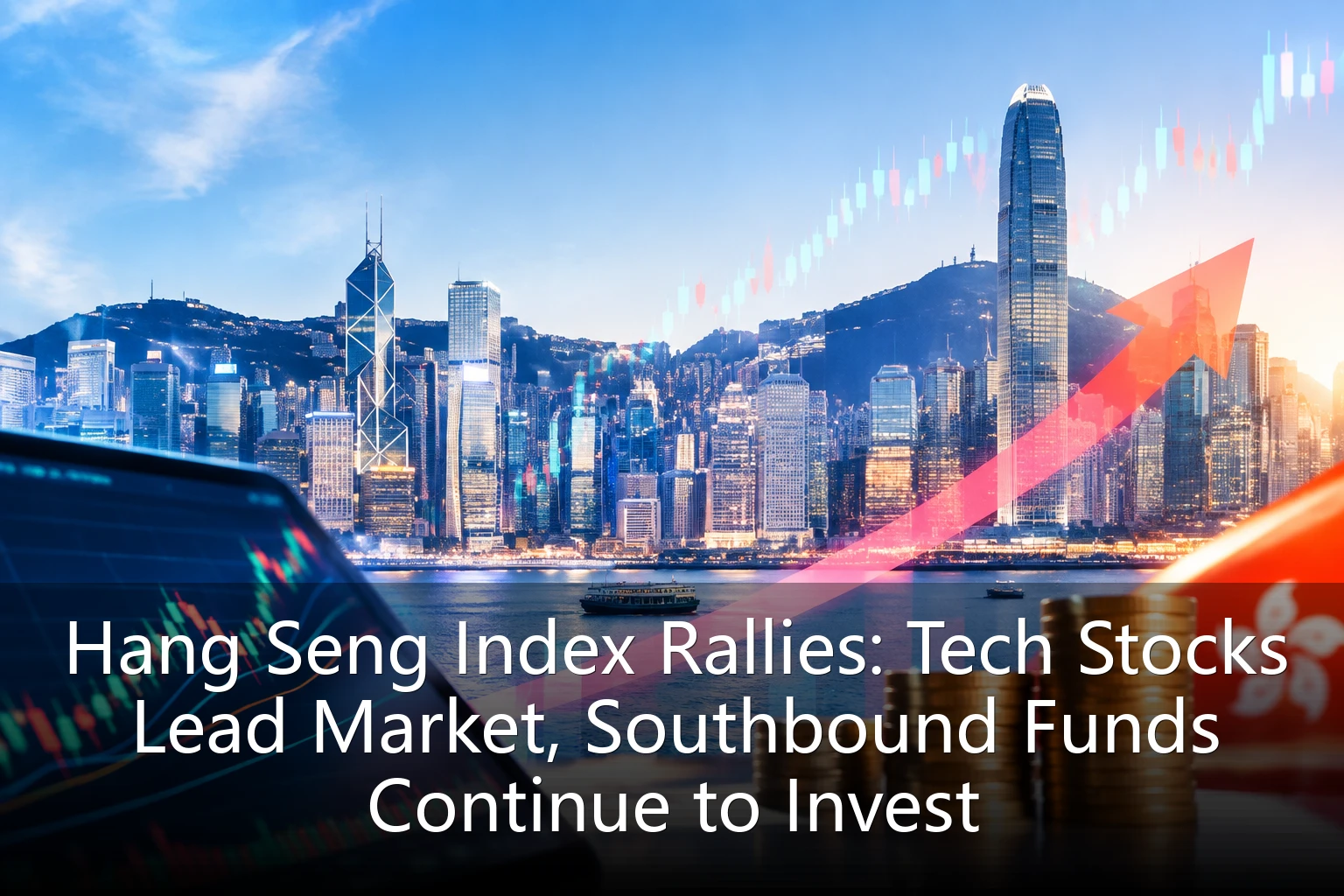
Hang Seng Index Rallies: Tech Stocks Lead Market, Southbound Funds Continue to Invest
\n\nIn September 2026, the Hong Kong stock market showed a volatile upward trend. Under the influence of multiple factors, the Hang Seng Index climbed steadily, with tech stocks becoming the main force leading the market rebound. With continuous inflow of southbound funds, the Hong Kong stock market has demonstrated strong resilience, providing investors with abundant investment opportunities. This article will conduct an in-depth analysis of the latest developments in the current Hong Kong stock market, explore how tech stocks and southbound funds jointly drive the Hang Seng Index upward, and provide investors with practical investment strategy recommendations.
\n\nLatest Hang Seng Index Trend Analysis
\n\nAs of September 30, 2026, the Hang Seng Index closed at 29,850 points, an increase of about 3.2% from the end of last month, showing strong market resilience. From a technical perspective, after finding support near the 28,500-point level, the Hang Seng Index has been fluctuating upward, breaking through the important psychological barrier of 29,000 points and attempting to challenge the 30,000-point level. In terms of trading volume, the market's average daily trading volume remained around 120 billion Hong Kong dollars, which has increased compared to the previous period, indicating that market participation is gradually increasing.
\n\nIn terms of sector performance, tech stocks have become the main force leading the market rebound. The Hang Seng Tech Index has been particularly impressive, with a monthly increase of over 5%, far exceeding the overall market performance. Among them, internet giants Tencent Holdings (00700.HK), Alibaba (09988.HK), and other leading stocks have seen significant gains, driving the strength of the entire tech sector. In addition, traditional sectors such as consumer and financial sectors have also performed steadily, providing strong support to the market.
\n\nMain Factors Affecting the Hang Seng Index
\n\nThe trend of the Hang Seng Index is affected by multiple factors, mainly including the following aspects:
\n\n- \n
- Macroeconomic Environment: As the global economy gradually recovers, especially with China's economy stabilizing and picking up, it has provided a favorable macro environment for the Hong Kong stock market. The latest data shows that China's GDP grew by 5.2% year-on-year in the third quarter, exceeding market expectations, laying a solid foundation for the profit growth of Hong Kong-listed companies. \n
- Policy Factors: Mainland China has continued to introduce policy measures to support the development of the capital market, such as optimizing the IPO system and expanding the interconnection mechanism, which has injected new vitality into the Hong Kong stock market. At the same time, the Hong Kong SAR government has also introduced a series of policies to attract foreign investment, further enhancing Hong Kong's status as an international financial center. \n
- Geopolitical Factors: Although geopolitical risks still exist, the recent tension has eased, reducing market uncertainty. Investors' concerns about China-US relations have eased, which is conducive to improving risk appetite. \n
- Capital Flows: The continuous inflow of southbound funds has become an important force driving the upward trend of the Hang Seng Index. Data shows that since September, the cumulative net inflow through Hong Kong Stock Connect has exceeded 30 billion RMB, a new high for the year, showing the confidence of mainland investors in the Hong Kong stock market. \n
The Impact of Tech Stocks on the Hang Seng Index
\n\nAs an important component of the Hang Seng Index, tech stocks have an increasingly significant impact on the index's trend. Recently, tech stocks have performed strongly, mainly driven by the following factors:
\n\n- \n
- Earnings Growth Expectations: With the rapid development of emerging technologies such as artificial intelligence and cloud computing, the profit prospects of technology companies are generally optimistic. The market expects that the profit growth rate of the tech sector will exceed the market average in the next few quarters, becoming the core driving force for the upward trend of the Hang Seng Index. \n
- Valuation Advantages: Compared with other major global markets, the valuation of Hong Kong-listed tech stocks is still at a relatively low level, with high investment attractiveness. Especially against the background that the Federal Reserve's interest rate hike cycle is approaching its end, the valuation advantage of growth stocks is more prominent. \n
- Policy Support: The Chinese government continues to increase support for technological innovation, introducing a series of policy measures to promote technological development, creating a favorable development environment for technology companies. \n
- Active Industry M&A: Recently, M&A activities in the tech industry have been frequent. Large technology companies are acquiring innovative companies to enhance their competitiveness, which further enhances market confidence in the tech sector. \n
In terms of sub-sectors, technology sub-sectors such as artificial intelligence, cloud computing, and semiconductors have performed particularly prominently. Among them, artificial intelligence-related companies have led the gains, reflecting the market's high attention to this emerging technology. With the rapid development of generative AI technologies such as ChatGPT, related application scenarios continue to expand, bringing new growth points for technology companies.
\n\nAnalysis of Southbound Fund Flows
\n\nAs an important source of incremental funds in the Hong Kong stock market, the flow of southbound funds has a significant impact on market trends. In September 2026, southbound funds showed a continuous net inflow trend, mainly showing the following characteristics:
\n\n- \n
- Continuously Expanding Inflow Scale: Since September, the average daily net inflow through Hong Kong Stock Connect has exceeded 1.5 billion RMB, a significant increase from August. Especially in the middle and late September, as the Hang Seng Index broke through the 29,000-point mark, southbound funds accelerated their inflow, with a single-day net inflow once exceeding 3 billion RMB. \n
- Changes in Investment Preferences: The investment preferences of southbound funds are changing. From the past preference for traditional blue-chip stocks such as finance and real estate, there is a gradual shift to sectors with growth potential such as technology and consumer goods. Data shows that in September, the allocation ratio of southbound funds to tech stocks increased by about 3 percentage points compared to the previous month. \n
- Active ETF Investment: Hong Kong Stock Connect ETFs have become an important allocation tool for southbound funds. In September, the net inflow of Hong Kong Stock Connect ETFs exceeded 5 billion RMB, a new high for the year. Among them, products such as Hang Seng Tech ETF and Hang Seng Chinese Enterprises ETF have received favor from funds. \n
- Increased Proportion of Long-term Funds: As mainland investors' understanding of the Hong Kong stock market deepens, the proportion of long-term funds is gradually increasing. Institutional investors are continuously allocating to high-quality Hong Kong stocks through Hong Kong Stock Connect, showing long-term confidence in the Hong Kong stock market. \n
Future Outlook for the Hong Kong Stock Market
\n\nLooking ahead, the Hong Kong stock market is expected to continue its volatile upward trend driven by multiple favorable factors. The following are several key trends worth paying attention to:
\n\n- \n
- Continuous Deepening of Interconnection Mechanism: With the continuous improvement of the interconnection mechanism between the mainland and Hong Kong capital markets, especially the introduction of new mechanisms such as "Swap Connect", it will further enhance the linkage between the two markets and bring more incremental funds to the Hong Kong stock market. \n
- Improvement in Corporate Earnings: With the global economic recovery and the stabilization and recovery of China's economy, the profit prospects of Hong Kong-listed companies are generally optimistic. Especially in sectors such as technology and consumer goods, corporate earnings are expected to achieve relatively rapid growth, providing support for stock price increases. \n
- Valuation Repair Space: Compared with other major markets, the valuation of the Hong Kong stock market is still at a relatively low level, with a large space for valuation repair. With the improvement of market sentiment, Hong Kong stocks are expected to usher in a valuation repair rally. \n
- Continuous Release of Institutional Dividends: In recent years, the Hong Kong Stock Exchange has continuously promoted institutional reforms, such as optimizing the IPO system and improving trading mechanisms. These institutional dividends will continue to be released, enhancing the competitiveness of the Hong Kong market. \n
Investment Strategy Recommendations
\n\nBased on the analysis of the current Hong Kong stock market, we provide the following investment strategy recommendations for different types of investors:
\n\n- \n
- Long-term Investors: It is recommended to focus on high-quality companies with core competitiveness, especially those with a leading position in fields such as technology and consumer goods. Through long-term holding, share in the returns brought by corporate growth. \n
- Medium-term Investors: You can pay attention to sectors with continuous inflow of southbound funds, such as technology and consumer goods. At the same time, you can appropriately allocate Hong Kong Stock Connect ETFs to achieve diversification and reduce the risk of individual stock selection. \n
- Short-term Investors: You can pay attention to hot sectors and individual stocks in the market, such as artificial intelligence and new energy. At the same time, closely follow the flow of southbound funds and changes in market sentiment, and flexibly adjust positions. \n
- Risk Management: Investors should fully understand the volatility of the Hong Kong stock market, reasonably control positions, set stop-loss points, and avoid large losses caused by market fluctuations. \n
In summary, the Hong Kong stock market showed a volatile upward trend in September 2026, with tech stocks leading the market rebound and southbound funds continuously flowing in. Looking ahead, driven by multiple favorable factors, the Hong Kong stock market is expected to continue its volatile upward trend. Investors should formulate appropriate investment strategies based on their own risk preferences and investment horizons to grasp the investment opportunities in the Hong Kong stock market.