

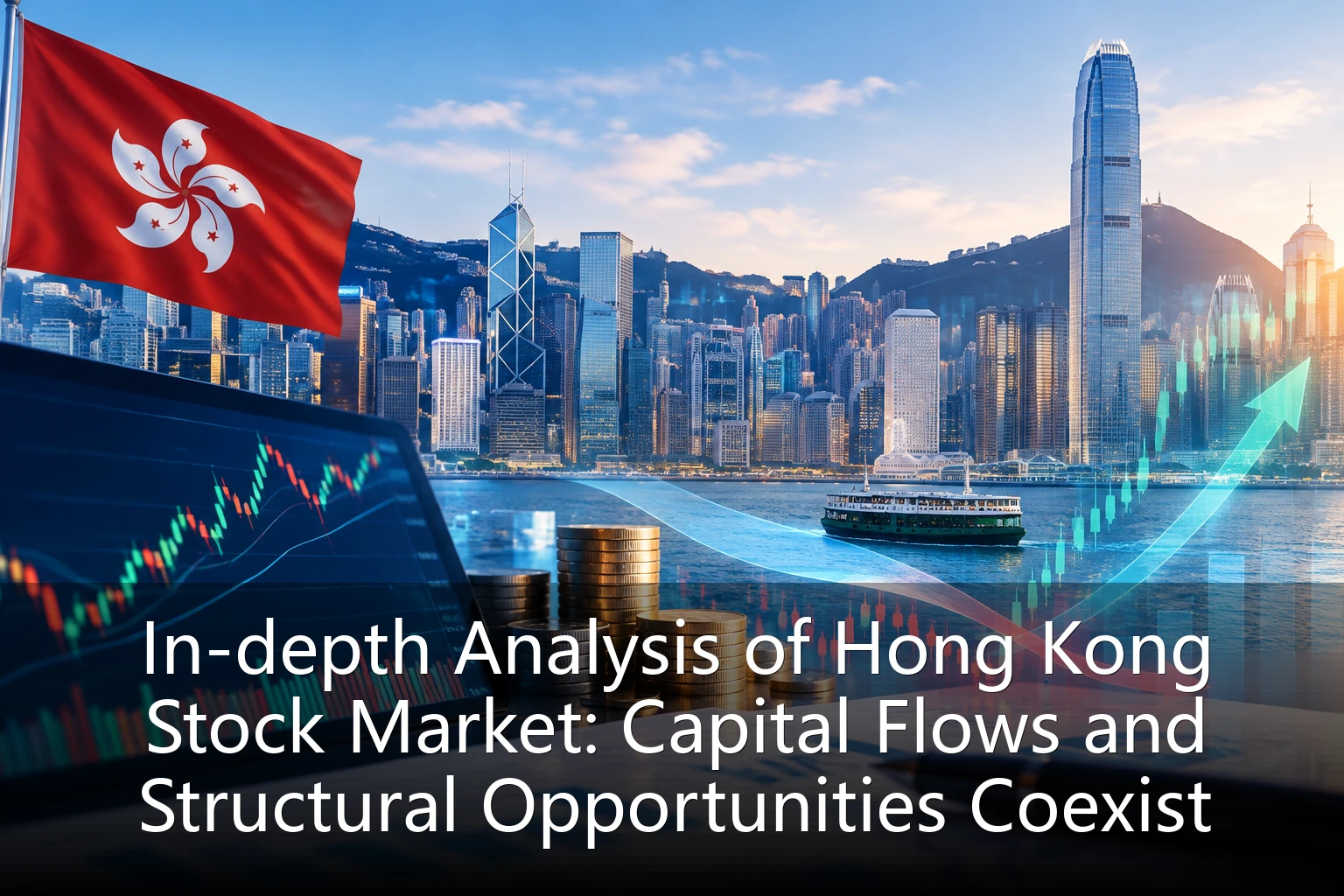
Recent Trend Analysis of Hong Kong Stock Market
Since the third quarter of 2026, the Hong Kong stock market has shown a volatile upward trend. After a previous adjustment, the Hang Seng Index reclaimed the 28,000-point mark in early September, subsequently consolidating in the 28,000-29,000 range. As of September 20's close, the Hang Seng Index closed at 28,560 points, down 0.3% from the previous trading day, but still achieved a monthly gain of 3.2%, reflecting the overall upward trend of the Hong Kong stock market.
Index Composition and Sector Rotation
In terms of index composition, the weight of technology stocks in the Hang Seng Index has continued to increase, becoming the main driving force for the market. Recently, internet platform companies, cloud computing, and artificial intelligence-related stocks have performed exceptionally well, with leading stocks such as Tencent Holdings and Alibaba hitting new highs. Meanwhile, traditional financial sectors have shown relatively stable performance, while the consumer sector has shown divergence, with high-end consumption continuing to strengthen while mass consumer goods face certain pressures.
Market Volatility Analysis
Notably, market volatility in Hong Kong has recently increased. On one hand, increased uncertainty in the global macroeconomic environment, including the Federal Reserve's monetary policy direction and geopolitical risks, has affected market sentiment. On the other hand, the structural adjustment of the Hong Kong stock market has also brought short-term fluctuations. However, from a long-term perspective, with the emergence of valuation advantages and continued capital inflows, the Hong Kong stock market still possesses considerable investment value.
Southbound Capital Flow Analysis
As a major force in the Hong Kong stock market, changes in southbound capital flows have a significant impact on market trends. Data shows that since 2026, southbound capital has continued to net flow into the Hong Kong market through the Stock Connect program, with the inflow rate accelerating significantly since September. As of September 20, southbound capital has accumulated net purchases exceeding 20 billion Hong Kong dollars this month, maintaining a net purchase status for 11 consecutive trading days, reflecting the confidence of mainland capital in the Hong Kong stock market.
Capital Allocation Preferences
In terms of capital allocation preferences, southbound capital mainly flows into three major sectors: technology, consumer, and financial. Among these, the technology sector is most favored, with large net purchases of internet giants such as Tencent Holdings, Meituan, and Xiaomi. In the consumer sector, high-end liquor and luxury brands have received strong capital interest, while mass consumer goods face some outflow pressure. In the financial sector, traditional institutions such as banks and insurance have seen stable inflows, while the securities sector has shown divergence.
Drivers of Capital Inflows
The continuous inflow of southbound capital into the Hong Kong stock market is mainly driven by several factors: first, the Hong Kong market offers significant valuation advantages compared to A-shares, with AH premium ratios at historically high levels; second, the high degree of internationalization and strong capital mobility in the Hong Kong market provide more convenience for investors; third, with the increasing openness of mainland capital markets, cross-border investment demand has grown; finally, quality stocks in technology, consumer, and other sectors in Hong Kong have attracted mainland capital attention.
Structural Opportunities in Hong Kong Stock Market
Against the backdrop of overall market volatility and upward movement, the Hong Kong stock market presents clear structural opportunities. From a sector perspective, there are good investment opportunities in technology, consumer, financial, and new energy sectors.
Technology Sector: Innovation-Driven Growth
The technology sector is one of the most dynamic sectors in the Hong Kong stock market. With the rapid development of artificial intelligence, cloud computing, big data, and other technologies, related companies have shown continuous growth. Especially in the AI application field, many Hong Kong-listed companies have launched innovative products and services, receiving positive market responses. Additionally, as mainland technology companies accelerate internationalization, Hong Kong's position as an international financial center provides an excellent platform for financing and business expansion.
Consumer Sector: Clear Upgrading Trend
The consumer sector plays an important role in the Hong Kong stock market and has shown a clear upgrading trend in recent years. On one hand, with the increase in mainland residents' income levels, demand for high-quality and personalized consumption has grown; on the other hand, mainland consumer brands are accelerating internationalization, entering the global market through Hong Kong. Especially in the high-end consumption sector, segments such as liquor, luxury goods, and high-end cosmetics have shown outstanding performance, providing good returns for investors.
Financial Sector: Valuation Advantages Emerge
The financial sector is a traditional strength of the Hong Kong stock market, with valuation advantages gradually emerging in recent years. On one hand, with the increasing openness of mainland financial markets, Hong Kong financial institutions have expanded business opportunities in the mainland market; on the other hand, as an international financial center, Hong Kong has unique advantages in wealth management and asset management. Additionally, with changes in the interest rate environment, the profitability of financial institutions such as banks and insurance companies is expected to improve.
Comparison of Hong Kong and A-Share Markets
Although both Hong Kong and A-share markets belong to China concept stocks, there are significant differences in market structure, valuation levels, and investment logic, providing different investment opportunities for investors.
Valuation Difference Analysis
In terms of valuation levels, the Hong Kong market is generally valued lower than the A-share market, especially in technology and consumer sectors, with AH premium ratios at historically high levels. Taking the Hang Seng Index as an example, its current P/E ratio is about 12 times, while the Shanghai Composite Index's P/E ratio is about 16 times in the same period, showing clear valuation advantages. This valuation difference mainly stems from different investor structures in the two markets - the Hong Kong market has a higher degree of internationalization with a larger proportion of institutional investors, while the A-share market has a higher proportion of individual investors.
Liquidity Comparison
In terms of liquidity, the Hong Kong market generally has lower liquidity than the A-share market, especially for some small and medium-cap stocks. However, for large blue-chip stocks, Hong Kong market liquidity is relatively good, particularly for stocks with high international investor participation. Additionally, the Hong Kong market has more flexible trading mechanisms, with features like T+0 trading and no price limit, providing more opportunities for short-term investors.
Investment Logic Differences
There are also significant differences in investment logic between Hong Kong and A-share markets. The A-share market focuses more on policy orientation and theme speculation, while the Hong Kong market emphasizes fundamental analysis and long-term value investing. This difference means that quality companies in the Hong Kong market often receive valuations that match their fundamentals, providing good opportunities for value investors.
Investment Recommendations for Thai Investors
For Thai investors, the Hong Kong stock market offers diversified investment opportunities. Based on current market conditions, we propose the following investment recommendations:
Asset Allocation Strategy
In terms of asset allocation, Thai investors can participate in Hong Kong market investment through the Stock Connect program. It is recommended to adopt a core-satellite strategy. The core portion should be allocated to Hang Seng Index ETFs or state-owned enterprise index ETFs to obtain market-average returns; the satellite portion should select quality individual stocks, especially leading companies in technology, consumer, and other sectors, to obtain excess returns. At the same time, allocation ratios can be adjusted according to market conditions to control risks.
Risk Management Measures
Risk management is an important aspect of cross-border investment. When participating in Hong Kong market investment, Thai investors need to pay attention to exchange rate risks, which can be hedged through tools such as foreign exchange forwards and options. Additionally, attention should be paid to policy risks, liquidity risks, and other factors, with reasonable position control to avoid over-concentration. Investors are advised to build diversified portfolios to spread risks.
Long-term Investment Perspective
The Hong Kong stock market has high short-term volatility, but still possesses considerable long-term investment value. Thai investors should adopt a long-term investment perspective, focusing on fundamental changes in companies rather than short-term market fluctuations. Especially for quality companies with core competitiveness, long-term holdings should be maintained to share the benefits of corporate growth. Meanwhile, with the continuous deepening of connectivity between mainland and Hong Kong capital markets, the investment value of the Hong Kong market will further increase.
Conclusion and Outlook
Overall, the Hong Kong stock market showed a volatile upward trend in the third quarter of 2026, with clear structural opportunities. Continuous southbound capital inflows and emerging market valuation advantages provide good investment opportunities for investors. Especially quality stocks in technology, consumer, and financial sectors deserve special attention.
Looking ahead, with continued mainland economic recovery and increasing openness of the Hong Kong financial market, the Hong Kong stock market is expected to usher in a new round of upward trend. Thai investors can participate in Hong Kong market investment through the Stock Connect program to share the benefits of China's economic growth. At the same time, attention should be paid to the impact of global macroeconomic environment changes and geopolitical risks on the market, and risk management should be properly handled.
In summary, as an important part of the international financial center, the Hong Kong stock market has unique investment value and advantages. Thai investors can achieve steady asset appreciation by deeply understanding market characteristics, grasping structural opportunities, and implementing proper risk management. Against the background of the current adjustment in the global economic landscape, the Hong Kong market provides an important channel for Thai investors to participate in China's economic development, deserving special attention and allocation.