

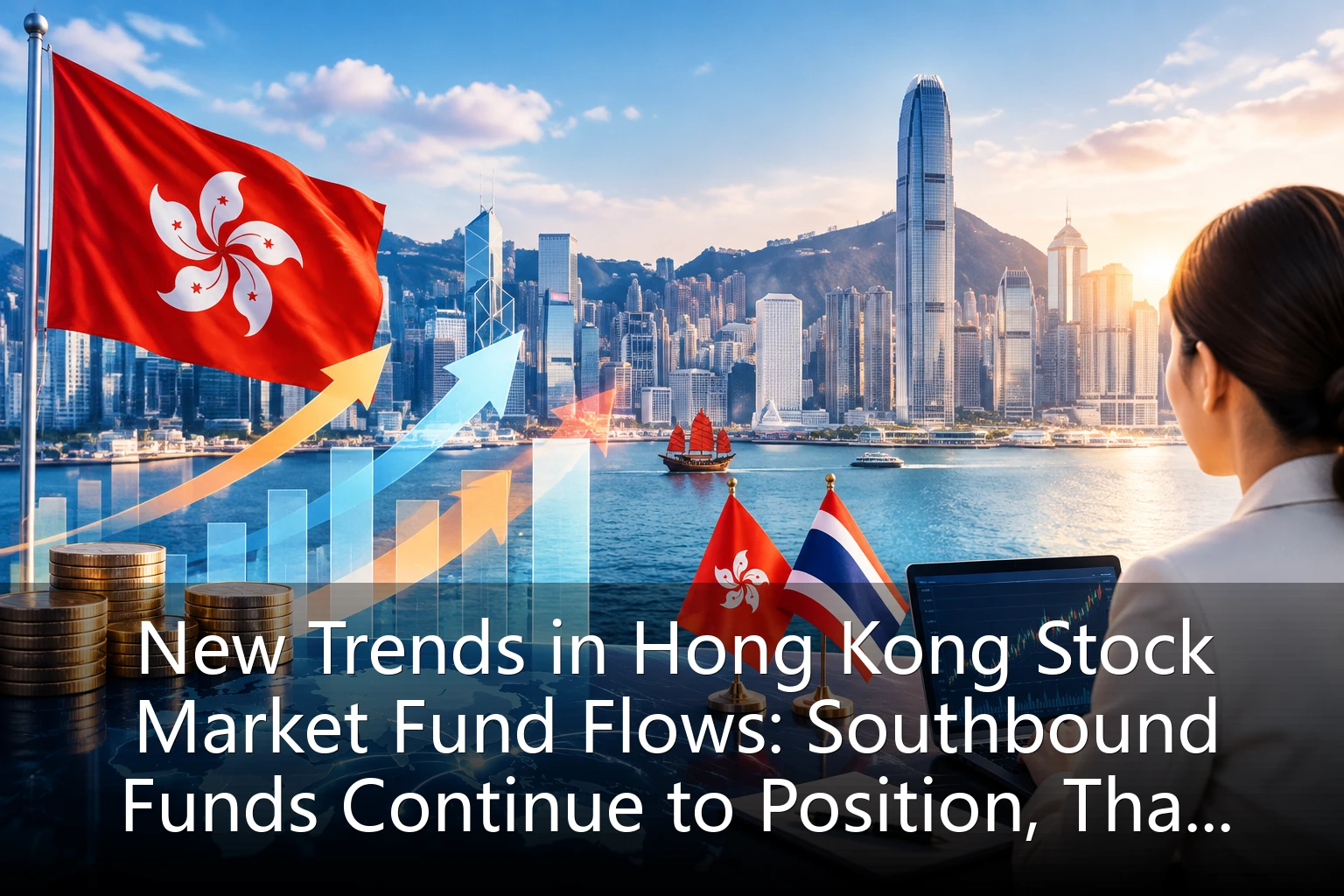
New Trends in Hong Kong Stock Market Fund Flows: Southbound Funds Continue to Position, Thai Investors Seize Cross-Border Opportunities
Recently, the fund flows in the Hong Kong stock market have shown significant changes, with southbound funds continuously flowing in, injecting new vitality into the market. As an important hub connecting mainland China and international capital markets, the fund flows in the Hong Kong stock market not only reflect market sentiment but also provide important decision-making references for investors. This article will conduct an in-depth analysis of the latest trends in Hong Kong stock market fund flows, explore the reasons for the continuous positioning of southbound funds, analyze structural opportunities in the Hong Kong stock market, and provide strategic recommendations for Thai investors to seize Hong Kong investment opportunities.
I. Latest Trends in Hong Kong Stock Market Fund Flows
As of mid-October 2026, the fund flows in the Hong Kong stock market have shown obvious structural characteristics. According to the latest data, southbound funds have continuously net flowed through the Stock Connect channel, especially with a significant acceleration in the speed of fund flows in recent times. This phenomenon indicates that the demand from international investors for allocating to mainland Chinese assets remains strong, and Hong Kong, as an important offshore market, has naturally become the preferred destination for fund allocation.
In terms of subdivided areas of fund flows, the technology sector and consumer sector have received the most favorable attention. With the recovery of the global technology industry and the rapid development of fields such as artificial intelligence and new energy, technology stocks in the Hong Kong market have attracted a large amount of capital inflow. At the same time, with the continuation of the domestic consumption upgrade trend, the consumer sector has also received stable financial support. This structural characteristic of fund flows reflects investors' confidence in the future development of the Hong Kong market.
In terms of geographical distribution, in addition to traditional southbound funds, the attention of Southeast Asian funds to the Hong Kong stock market is also continuously increasing. Thailand, as an important economy in Southeast Asia, has seen its investors' participation in the Hong Kong stock market gradually increasing. This diversified fund flow pattern has injected new vitality into the Hong Kong stock market and provided investors with more diversified investment opportunities.
II. Analysis of the Reasons for Continuous Inflow of Southbound Funds
The continuous inflow of southbound funds into the Hong Kong stock market is driven by multiple factors. Firstly, from a valuation perspective, although the Hong Kong stock market has risen recently, its overall valuation level is still at a historical low, showing obvious valuation advantages compared to other major global markets. Especially for high-quality enterprises in mainland China, their valuations in the Hong Kong market are often lower than in the A-share market, which provides good investment opportunities for investors.
Secondly, from a policy environment perspective, mainland China has continuously promoted the opening of its capital market in recent years, with the Stock Connect mechanism being continuously improved and investment restrictions gradually relaxed. These policy measures have created more convenient conditions for the inflow of southbound funds, lowering investment thresholds and improving investment efficiency. Especially the implementation of the expansion policy for Stock Connect ETFs has provided investors with more diversified investment tools, further attracting capital inflows.
Thirdly, from a market structure perspective, the Hong Kong market, as an international financial center, has unique institutional advantages and liquidity advantages. Compared with the mainland market, the Hong Kong market implements a T+1 trading system with more flexible trading mechanisms. At the same time, it has a higher market maturity and a complete regulatory system, which makes the Hong Kong market highly attractive to international investors.
Finally, from an asset allocation perspective, against the background of increasing global economic uncertainty, investors' demand for diversified asset allocation is increasingly strong. The Hong Kong market, as a bridge between mainland China and the international market, provides investors with a convenient channel for allocating to Chinese assets, while also reducing investment risks in a single market.
III. Structural Opportunities in the Hong Kong Stock Market
Driven by fund flows, the Hong Kong stock market has shown obvious structural opportunities. Firstly, the technology sector, as the main driving force in the market, has broad future development prospects. With the rapid development of technologies such as artificial intelligence, cloud computing, and big data, the profitability of technology companies continues to improve, and their valuation levels are expected to be restored. Especially those enterprises with core technological advantages and market competitiveness are expected to receive more favor from funds.
Secondly, the consumer sector, as a stabilizer of the economy, also occupies an important position in fund flows. With the continuation of the domestic consumption upgrade trend, the profitability of consumer enterprises is expected to continue to improve. Especially those consumer enterprises with brand advantages and channel advantages are expected to receive stable financial support and achieve long-term value growth.
Thirdly, the new energy sector, as an important direction for future energy transformation, has also attracted a large amount of capital inflow. Against the background of global carbon neutrality goals, the development prospects of the new energy industry are broad. The Hong Kong market, as an important platform for new energy enterprises to raise funds, is expected to attract more high-quality enterprises to list, providing investors with more investment opportunities.
In addition, the financial sector, as a traditional advantage sector in the Hong Kong market, also occupies an important position in fund flows. With the opening of the mainland financial market, financial institutions in the Hong Kong market are expected to get more development opportunities. Especially those financial institutions with international operation capabilities and innovation capabilities are expected to receive more favor from funds.
IV. How Thai Investors Can Seize Hong Kong Investment Opportunities
For Thai investors, seizing Hong Kong investment opportunities requires consideration from multiple dimensions. Firstly, investors need to fully understand the characteristics and rules of the Hong Kong market, including trading mechanisms, regulatory systems, tax policies, etc. Especially for Thai investors participating in Hong Kong stock investment for the first time, understanding these basic knowledge is crucial.
Secondly, investors need to pay attention to changes in fund flows and grasp market hotspots. By analyzing the flows of southbound funds and Southeast Asian funds, investors can better grasp the structural opportunities in the market. Especially for those sectors and individual stocks that have received a large amount of capital inflow, investors can pay appropriate attention.
Thirdly, investors need to allocate assets reasonably and control risks. Although the Hong Kong stock market has good investment opportunities, there are also certain market risks. Investors need to allocate assets reasonably according to their risk tolerance and avoid over-concentrated investment. Especially for Thai investors, they need to pay attention to the exchange rate fluctuations between the Thai baht and the Hong Kong dollar and manage exchange rate risks reasonably.
Fourthly, investors can use cross-border investment tools such as Stock Connect to participate in Hong Kong stock investment conveniently. With the opening of the mainland capital market, the Stock Connect mechanism has been continuously improved, providing more convenient investment channels for Thai investors. Investors can invest in high-quality stocks in the Hong Kong market through Stock Connect and share the dividends of China's economic growth.
Finally, investors can pay attention to investment tools such as Hong Kong stock ETFs to achieve diversified investment. Hong Kong stock ETFs have the characteristics of convenient trading, low cost, and risk diversification, making them suitable for Thai investors for long-term investment. Especially for investors who lack experience in individual stock selection, ETF is a good choice.
V. Future Outlook and Investment Strategy Recommendations
Looking ahead, the fund flows in the Hong Kong stock market are expected to maintain an active trend. With the continuous recovery of mainland China's economy and the further opening of the capital market, the trend of southbound funds flowing into the Hong Kong stock market is expected to continue. At the same time, with the increasing attention of Southeast Asian investors to the Hong Kong stock market, a diversified capital pattern will inject new vitality into the Hong Kong stock market.
For Thai investors, seizing Hong Kong investment opportunities requires formulating reasonable investment strategies. Firstly, it is recommended that investors adopt a long-term investment strategy to avoid the impact of short-term market fluctuations. Although the Hong Kong market has large short-term fluctuations, the value growth potential of high-quality enterprises is still considerable in the long run.
Secondly, it is recommended that investors pay attention to sectors with growth potential such as technology, consumption, and new energy to grasp structural opportunities. These sectors not only have strong growth potential but also conform to the general trend of global economic development and are expected to receive continuous financial support.
Thirdly, it is recommended that investors use tools such as Stock Connect and Hong Kong stock ETFs to facilitate cross-border investment. These tools can not only lower investment thresholds but also improve investment efficiency, providing investors with more investment choices.
Finally, it is recommended that investors strengthen risk management and control positions reasonably. Although the Hong Kong market has good investment opportunities, there are also certain market risks. Investors need to allocate assets reasonably according to their risk tolerance and avoid over-concentrated investment.
In conclusion, changes in Hong Kong stock market fund flows provide important decision-making references for investors. For Thai investors, seizing Hong Kong investment opportunities requires in-depth understanding of market characteristics, attention to changes in fund flows, reasonable asset allocation, and risk control. By formulating reasonable investment strategies, Thai investors are expected to obtain considerable investment returns in the Hong Kong market and achieve steady wealth growth.