

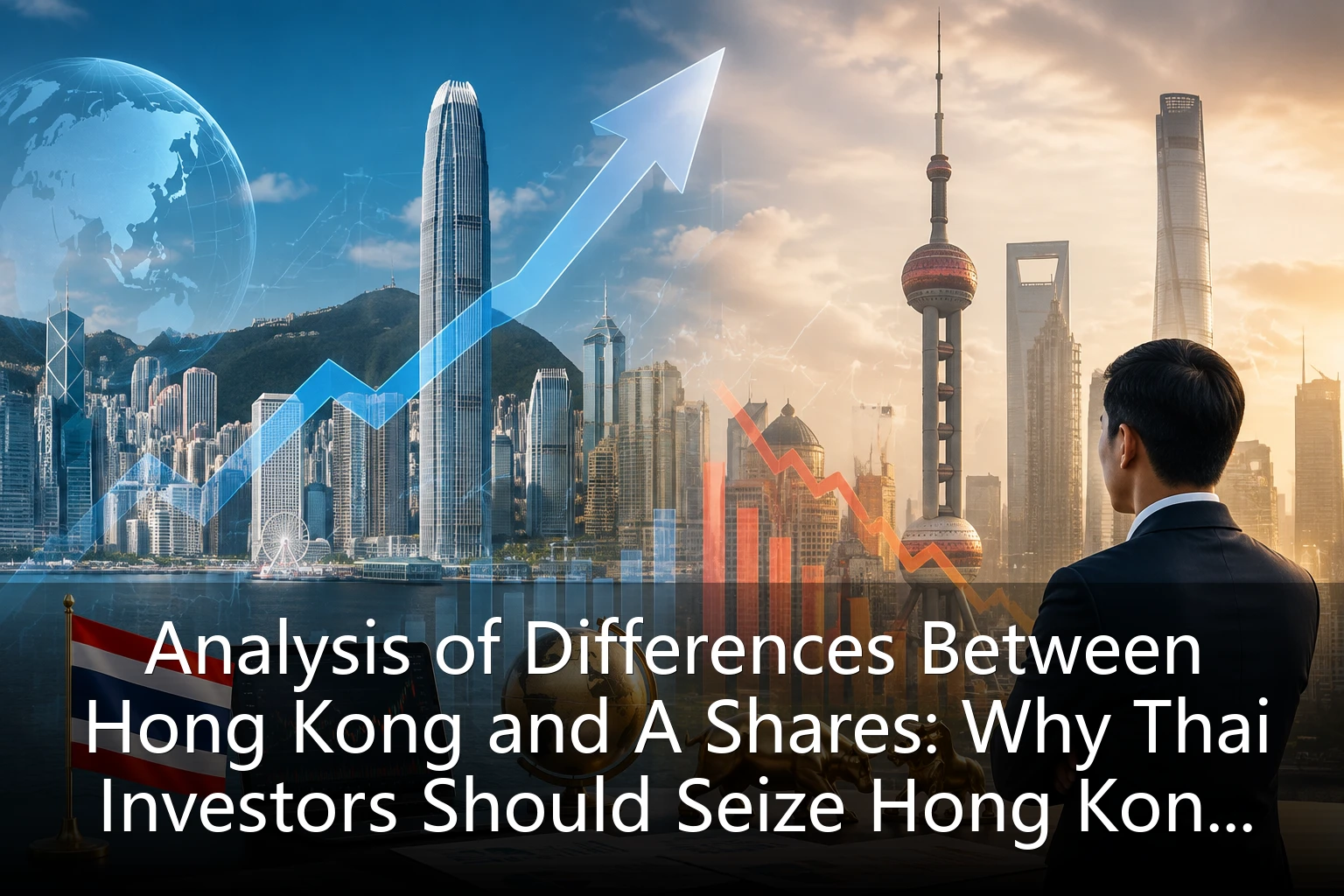
Analysis of Differences Between Hong Kong and A Shares: Why Thai Investors Should Seize Hong Kong Stock Investment Opportunities
In the global investment landscape, the Hong Kong stock market has attracted numerous international investors, including those from Thailand, with its unique advantages. With the continuous development of China's economy and the gradual opening of its capital market, Hong Kong stocks, as an important bridge connecting mainland China and international capital, are increasingly showing their investment value. This article will start with the core differences between Hong Kong and A-shares, deeply analyze the unique advantages of the Hong Kong stock market, and help Thai investors seize new opportunities in cross-border investment.
I. Market Positioning Differences Between Hong Kong and A Shares
The Hong Kong stock market, full name Hong Kong Stock Exchange, is one of Asia's leading international financial centers, with over 2,500 listed companies and total market value ranking among the highest globally. Compared to the A-share market, the Hong Kong stock market has distinct international characteristics: listed companies come from multiple countries and regions, the investor structure is international, trading mechanisms are flexible, and capital inflows and outflows are highly free.
In contrast, the A-share market mainly targets mainland Chinese investors. Although it has gradually opened through mechanisms like Shanghai-Hong Kong Stock Connect and Shenzhen-Hong Kong Stock Connect in recent years, its overall internationalization level still has significant room for improvement. This difference in market positioning directly leads to significant differences between the two markets in terms of valuation levels, liquidity, and investment products.
II. Valuation Advantage: Hong Kong Stock Market as a Value Valley
From a valuation perspective, the Hong Kong stock market has long been in a valuation valley among major global capital markets. Taking data from August 2026 as an example, the Hang Seng Index's P/E ratio is about 10-12 times, while the Shanghai Composite Index's P/E ratio is about 15-18 times during the same period. This valuation difference mainly stems from the following factors:
- Investor Structure Differences: The Hong Kong stock market has a high proportion of institutional investors, with rational pricing dominating; while the A-share market has a larger proportion of individual investors, leading to greater market sentiment fluctuations.
- Capital Liquidity Differences: The Hong Kong stock market has free capital flows without foreign exchange control restrictions; while the A-share market has certain capital flow restrictions.
- Market Maturity Differences: The Hong Kong stock market has a longer history, more mature market mechanisms, and more rational risk perception among investors.
For Thai investors, the valuation advantage of the Hong Kong stock market means higher investment safety margins and potential returns. Especially against the backdrop of increasing global economic uncertainty, the relative valuation advantage of Hong Kong stocks is more pronounced.
III. Trading Mechanism: Flexibility Advantage of the Hong Kong Stock Market
The Hong Kong stock market has significant flexibility advantages in trading mechanisms, which is also an important factor attracting international investors:
- Longer Trading Hours: The Hong Kong stock market trading hours are 9:30-12:00 AM and 1:00-4:00 PM, half an hour longer than the A-share market.
- T+0 Trading System: Hong Kong implements a T+0 trading system, where investors can sell stocks on the same day they buy them, improving capital utilization efficiency.
- No Price Limit: The Hong Kong stock market has no price limit restrictions, allowing for fuller price discovery, but also meaning greater volatility.
- Rich Trading Products: In addition to stocks, the Hong Kong stock market offers a variety of derivatives such as options, futures, bull/bear certificates, providing investors with more risk management tools.
These trading mechanism advantages make the Hong Kong stock market more investment flexible and capable of risk management, suitable for Thai investors with certain investment experience.
IV. Degree of Internationalization: Global Perspective of the Hong Kong Stock Market
As an international financial center, the Hong Kong stock market has a high degree of internationalization:
- Diversified Listed Companies: Hong Kong listed companies include not only Chinese enterprises but also a large number of international companies, providing investors with diversified investment choices.
- International Investors: The Hong Kong stock market attracts institutional and individual investors from around the world, with more transparent market information and more reasonable pricing.
- International Regulatory System: Hong Kong market regulation follows international standards, with strict information disclosure requirements and perfect mechanisms for protecting investor rights.
For Thai investors, the international characteristics of the Hong Kong stock market mean access to more diverse investment opportunities while enjoying international regulatory protection.
V. Capital Flows: Convenient Channel of the Hong Kong Stock Market
The Hong Kong stock market has significant advantages in terms of capital flows:
- No Foreign Exchange Controls: Hong Kong has no foreign exchange controls, with free capital inflows and outflows, facilitating cross-border investment for Thai investors.
- Free Convertibility of HKD: The Hong Kong dollar is a freely convertible currency, facilitating capital management and hedging for Thai investors.
- Interconnection Mechanisms: Through mechanisms like Hong Kong Stock Connect, Thai investors can conveniently invest in the Hong Kong stock market.
These advantages make the Hong Kong stock market an important choice for Thai investors' cross-border investment, especially against the backdrop of increasing global economic uncertainty.
VI. Investment Strategy: Hong Kong Stock Allocation for Thai Investors
For Thai investors, investing in the Hong Kong stock market requires formulating appropriate investment strategies:
1. Asset Allocation Strategy
It is recommended that Thai investors treat Hong Kong stock investment as an important part of global asset allocation, allocating 10%-30% of assets to the Hong Kong stock market according to their risk tolerance and investment objectives. The specific allocation ratio can be adjusted according to market conditions and investment goals.
2. Industry Selection Strategy
The Hong Kong stock market has a wide industry distribution. Thai investors can choose suitable industries for investment based on their professional knowledge and risk preferences. Currently, new economy, technology, consumption, and finance industries in the Hong Kong stock market have high investment value.
3. Risk Management Strategy
The Hong Kong stock market is more volatile, so Thai investors need to establish a comprehensive risk management mechanism:
- Diversified investment: Do not concentrate all funds in a single stock or industry; diversify investments.
- Stop-loss strategy: Set reasonable stop-loss points to control the maximum loss of a single investment.
- Hedging strategy: Use derivative tools in the Hong Kong stock market, such as options and futures, for risk hedging.
4. Long-term Investment Strategy
The Hong Kong stock market has high short-term volatility but shows good investment value in the long term. Thai investors should adopt a long-term investment strategy and avoid being influenced by short-term market fluctuations when making investment decisions.
VII. Practical Guide: Hong Kong Stock Investment Path for Thai Investors
For Thai investors, there are several ways to invest in the Hong Kong stock market:
1. Hong Kong Stock Connect Mechanism
Hong Kong Stock Connect is an important mechanism connecting mainland China and Hong Kong stock markets. Thai investors can invest in the Hong Kong stock market through Hong Kong Stock Connect. The specific operation steps are as follows:
- Open a Hong Kong Stock Connect account: Open a Hong Kong Stock Connect account through a local securities firm in Thailand.
- Transfer funds: Convert Thai baht to Hong Kong dollars and transfer to the Hong Kong Stock Connect account.
- Stock trading: Conduct Hong Kong stock trading through the Hong Kong Stock Connect trading system.
- Withdraw funds: After selling stocks, funds can be transferred back to the Thai baht account.
2. Direct Account Opening
Thai investors can also directly open an account with a securities firm in Hong Kong to directly invest in the Hong Kong stock market. Although this method is more flexible, it requires more procedures and higher thresholds.
3. Invest in Hong Kong Stock ETFs
For Thai investors unfamiliar with the Hong Kong stock market, they can indirectly invest in the Hong Kong stock market by investing in Hong Kong Stock ETFs. Hong Kong Stock ETFs have advantages such as convenient trading, low costs, and risk diversification, making them suitable for beginners.
VIII. Risk Warnings and Investment Recommendations
Although the Hong Kong stock market has many advantages, Thai investors should pay attention to the following risks during the investment process:
- Exchange Rate Risk: Exchange rate fluctuations between the Thai baht and Hong Kong dollar may affect investment returns.
- Market Risk: The Hong Kong stock market is more volatile, and price fluctuations may lead to investment losses.
- Policy Risk: Policy changes in mainland China and Hong Kong may affect the Hong Kong stock market.
- Liquidity Risk: Some Hong Kong stocks have poor liquidity, which may lead to difficulties in buying and selling.
To mitigate these risks, Thai investors can take the following measures:
- Reasonably allocate assets and do not invest all funds in the Hong Kong stock market.
- Pay attention to exchange rate changes and conduct hedging at appropriate times.
- Choose stocks with better liquidity for investment.
- Closely monitor policy changes and adjust investment strategies in a timely manner.
Conclusion
The Hong Kong stock market and A-share market have significant differences in market positioning, valuation levels, trading mechanisms, and degree of internationalization. These differences make the Hong Kong stock market uniquely attractive to Thai investors. Through reasonable asset allocation, industry selection, and risk management, Thai investors can fully utilize the investment opportunities in the Hong Kong stock market to achieve asset preservation and appreciation.
With the continuous development of China's economy and the gradual opening of its capital market, the investment value of the Hong Kong stock market will further increase. Thai investors should seize this historical opportunity to share in the dividends of China's economic development through the Hong Kong stock market and achieve diversified allocation of cross-border investments.
In conclusion, as an important bridge connecting mainland China and international capital, the Hong Kong stock market provides rich investment opportunities for Thai investors. By deeply understanding the differences between Hong Kong and A-shares and formulating appropriate investment strategies, Thai investors can achieve satisfactory returns in the Hong Kong stock market.