

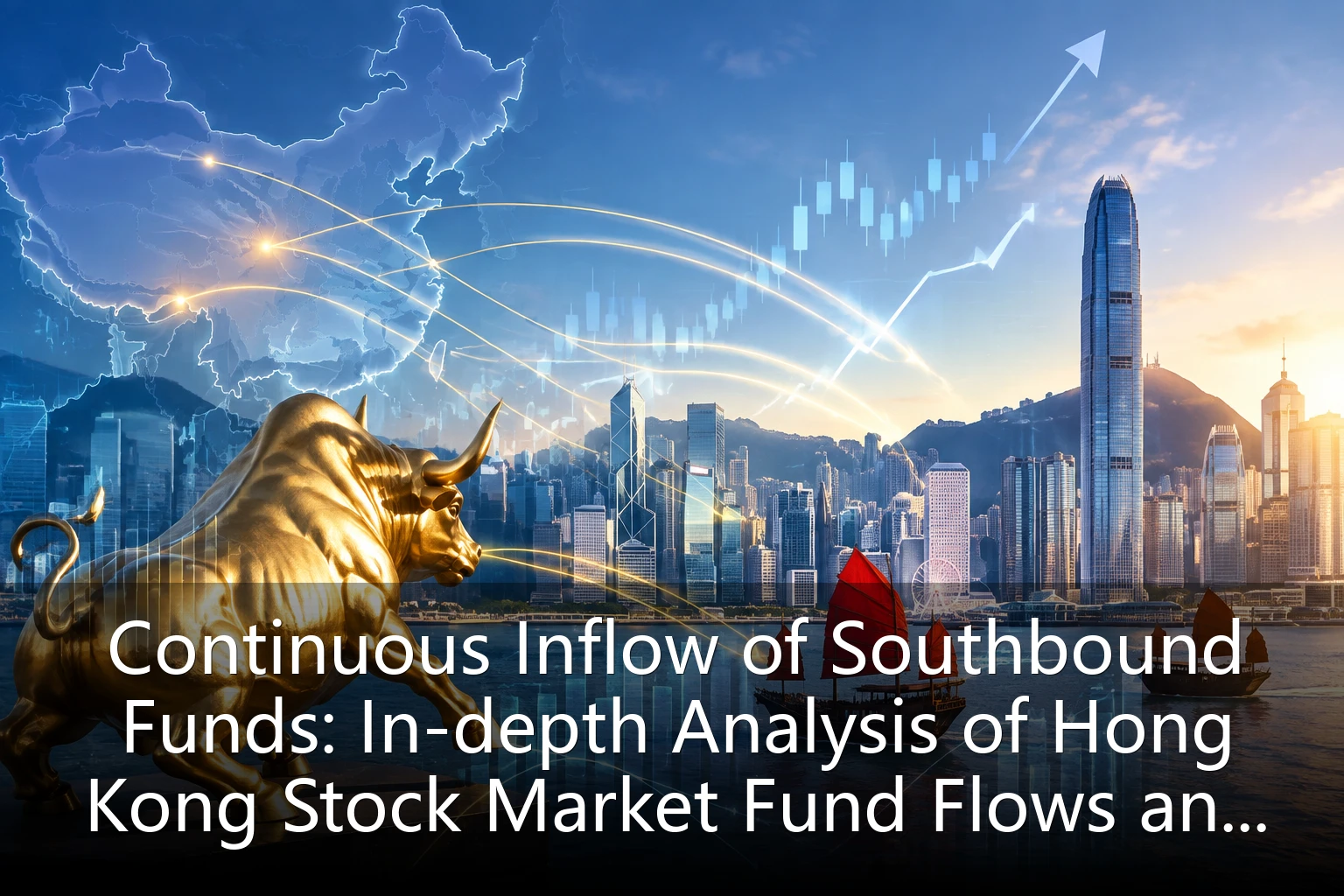
Continuous Inflow of Southbound Funds: In-depth Analysis of Hong Kong Stock Market Fund Flows and Investment Strategies
\nIn August 2026, the Hong Kong stock market continued to attract Southbound funds, with fund flow data showing that mainland investors have been continuously net buying Hong Kong stocks through the Stock Connect program. This phenomenon not only reflects the current valuation advantages of the Hong Kong stock market but also reveals new trends in cross-border capital allocation. This article will conduct an in-depth analysis of the characteristics of recent Hong Kong stock market fund flows, the market logic behind them, and provide corresponding investment strategy recommendations for investors.
\n\nI. Analysis of Southbound Fund Flows
\nAccording to the latest data, since August 2026, Southbound funds have recorded net purchases for 12 consecutive trading days through the Stock Connect program, with a cumulative net inflow exceeding 38 billion Hong Kong dollars. This inflow represents an increase of about 15% compared to the same period last year, indicating that mainland investors' confidence in the Hong Kong stock market continues to strengthen.
\n\nIn terms of fund structure, Southbound funds mainly flow into the following sectors: technology stocks, consumer stocks, financial stocks, and some state-owned enterprise stocks with high dividends. Among these, the technology sector is the most favored, accounting for 42% of net inflows, reflecting investors' optimistic expectations for the future development prospects of Hong Kong's technology companies.
\n\nNotably, the inflow pattern of Southbound funds shows a clear "buying the dip" characteristic. When the Hang Seng Index undergoes periodic adjustments, Southbound funds often increase their buying momentum. This contrarian operation demonstrates mainland investors' recognition of the long-term value of Hong Kong stocks.
\n\nII. Changes in Fund Structure of the Hong Kong Stock Market
\nIn recent years, the fund structure of the Hong Kong stock market has undergone significant changes. The proportion of traditional international institutional investors has gradually decreased, while the proportion of mainland investors has continued to rise. Currently, Southbound funds account for about 18% of the daily trading volume in the Hong Kong stock market, becoming an important force that cannot be ignored.
\n\nThis change in fund structure has led to a reshaping of market style. On one hand, mainland investors are more familiar with the business models and development prospects of Chinese enterprises, allowing undervalued quality Chinese enterprises to receive more reasonable valuations. On the other hand, the continuous inflow of Southbound funds has brought new liquidity to the Hong Kong stock market, reducing market volatility.
\n\nFurthermore, the continuous improvement of the mutual market access mechanism has also facilitated capital flows. In 2026, the list of eligible stocks under the Stock Connect program was further expanded, adding more new economy enterprises that meet the criteria. This has broadened the investment scope for Southbound funds and attracted more mainland capital to participate in the Hong Kong stock market.
\n\nIII. Market Logic Behind Fund Flows
\nThe continuous inflow of Southbound funds into the Hong Kong stock market is driven by multiple factors:
\n\n- \n
- Valuation Advantages: Compared to the A-share market, many quality Chinese enterprises in the Hong Kong stock market still exist at a valuation discount, providing mainland investors with opportunities for "value discovery." \n
- Asset Allocation Needs: As mainland investors' awareness of global asset allocation increases, Hong Kong, as a bridge connecting China and global capital markets, has become an important allocation target. \n
- Policy Support: The China Securities Regulatory Commission continues to optimize the mutual market access mechanism, facilitating the flow of Southbound funds and continuously releasing policy dividends. \n
- Improved Market Environment: In recent years, the Hong Kong market has continuously improved in terms of regulatory systems, trading mechanisms, etc., making the market environment more mature and attracting more long-term capital. \n
IV. Characteristics of Fund Flows in Different Sectors
\nIn terms of fund flows across different sectors, distinct differentiation characteristics are evident:
\n\n1. Technology Sector
\nTechnology stocks are one of the sectors most favored by Southbound funds. This is mainly driven by the following factors: first, the profitability of Hong Kong technology companies continues to improve; second, new technologies such as artificial intelligence and cloud computing bring growth momentum; third, the demonstration effect of global technology giants listing in Hong Kong.
\n\n2. Consumer Sector
\nFund inflows in the consumer sector are relatively stable, mainly concentrated in leading enterprises with brand advantages and channel advantages. As the trend of consumption upgrading in the mainland continues, Hong Kong consumer companies benefit from the recovery of cross-border consumption, with positive performance expectations.
\n\n3. Financial Sector
\nFund inflows in the financial sector show periodic characteristics, with funds typically flowing to defensive financial stocks such as banks and insurance when market volatility increases. Currently, Hong Kong's banking sector demonstrates stable profitability and attractive dividend rates, attracting the allocation of conservative funds.
\n\n4. High Dividend Sector
\nIn the current interest rate environment, the high dividend strategy is favored by funds. High dividend sectors in the Hong Kong market such as utilities and telecommunications continue to receive net fund inflows, becoming a "safe haven" for capital.
\n\nV. Future Fund Flow Trends Forecast
\nLooking ahead, Hong Kong stock market fund flows may show the following trends:
\n\n- \n
- The trend of Southbound fund inflows is expected to continue, with an estimated annual net inflow exceeding 500 billion Hong Kong dollars. \n
- As the valuation gap between A-shares and Hong Kong stocks gradually narrows, fund flows will focus more on corporate fundamentals and long-term value. \n
- New economy enterprises will continue to attract fund attention, especially those with technological innovation capabilities and global competitiveness. \n
- ESG investment concepts will influence fund flows, with enterprises demonstrating good sustainability performance receiving more favor from funds. \n
VI. Investor Response Strategies
\nBased on the analysis of Hong Kong stock market fund flows, investors can adopt the following strategies:
\n\n1. Monitor Fund Flow Indicators
\nInvestors should closely monitor indicators such as daily net purchases of Southbound funds and changes in industry allocation to grasp market capital trends. The Hong Kong Stock Exchange's official website and financial data terminals are important channels for obtaining fund flow data.
\n\n2. Prefer Sectors with Concentrated Fund Inflows
\nHistorical data shows that sectors with continuous Southbound fund inflows often perform better. Investors can focus on sectors with high rankings in net inflows to find investment opportunities.
\n\n3. Balance Value and Growth
\nIn the current market environment, investors should balance value and growth, focusing on value stocks with reasonable valuations and stable cash flows, while also positioning in technology stocks with high growth potential.
\n\n4. Diversify Investments to Reduce Risk
\nThe Hong Kong stock market is highly volatile, so investors should adopt a diversified investment strategy using tools such as ETFs and sector funds to reduce single-stock risk. At the same time, reasonably control position sizes to avoid excessive concentration.
\n\n5. Adopt a Long-term Holding Perspective
\nThe Hong Kong stock market experiences significant short-term fluctuations, but in the long run, the value of quality enterprises will eventually be reflected. Investors should establish a long-term investment philosophy and avoid being influenced by short-term market fluctuations when making investment decisions.
\n\nVII. Conclusion
\nIn August 2026, the continuous inflow of Southbound funds into the Hong Kong stock market shows mainland investors' recognition of Hong Kong's value. This trend is the result of multiple factors including valuation advantages, asset allocation needs, and policy support. Looking at the characteristics of fund flows across different sectors, technology, consumer, and financial sectors each have their own appeal.
\n\nLooking ahead, as the mutual market access mechanism further improves and mainland investors' awareness of global asset allocation increases, Southbound funds are expected to continue flowing into the Hong Kong stock market. Investors should closely monitor changes in fund flows, adopt a balanced investment strategy of value and growth, reduce risks through diversification, and establish a long-term investment perspective.
\n\nOverall, Hong Kong stock market fund flows are an important indicator for judging market trends. By deeply understanding the logic and characteristics of capital flows, investors can better grasp the market pulse and make wise investment decisions to obtain long-term stable investment returns in the Hong Kong stock market.
\n